Showing posts with label musings. Show all posts

Saturday, February 10, 2007

Challenge #2: What You Like Most About Second Life

Mera poses the challenge: Tell us what you like most about Second Life.

Dolmere wrote in his response to the challenge:

I still remember Mera exclaiming something like "I love this place. It's good to know that the skills I have spent my life learning are appreciated somewhere".
That reflects much of the appeal of Second Life to me: the sense of efficacy and satisfaction that I derive from it. The things that I love are things that matter in Second Life. And I love what things matter in Second Life.

Consider a game such as, say, World of Warcraft, the massively multiplayer online stupefacient that held my attention prior to joining Second Life. I could perform decently in such a game, but the things that mattered—the things around which the hierarchy of reputation was formed—were the ability to kill things quickly, and the ability to kill other things quickly. Rarely was there reverance for a great healer; appreciation, of course, because they helped the other people continue to kill things; but not reverance.

I was never very competetive by nature, nor was I destructive. I found more satisfaction in cooperation and creation. I did not care to organize a group of other players to attack the enemy's home cities and kill their citizens. I would rather (and did, on several occasions) organize a dance-raid: march into the enemy city and have a peaceful dance party with the enemy! (For some reason, the enemy did not usually appreciate my efforts.)

Second Life was different.

Many people take great pains to stress that Second Life is not a game. But for me, it always has been a game—of sorts—and one that I was good at (and more, enjoyed!). In this amazing new game, instead of killing things, people created things. Instead of smacking each other with swords, they joined hands and made the world better. The people who were most widely-known and respected were renowned for their creative ability or friendliness! What a marvelous thing to find!

Of course, the "rules" to this "game" aren't as concretely established as in Warcraft, and everybody "plays" a different way. But for me, every time I create a new sculpture or enjoy an activity with my friends, it's more satisfying and rewarding than killing monsters or running around from place to place ever was.

So, what do I like most about Second Life?

It's not the amazing and wonderful people I've met. It's not the dynamic environment. It's not even the building.

It's the attitude and spirit.

Create, not destroy.
Help, not harm.
Join together, not tear apart.

Everything worthwhile in Second Life is a branch on this tree.

Monday, January 29, 2007

Wednesday, December 20, 2006

On the Technical Town Hall

Some excerpts from the Technical Town Hall transcript that I found particularly interesting or insightful, for whatever reason. Quotes are sometimes followed by my comments, when I have something to add. All emphasis in the quotes is mine.

Server scaling, other than the centralized services issues I just covered, is primarily a function texture prioritization/downloading, script processing, physical simulation, and interest list calculation.

The phrase interest list calculation gave me a fascinating little peek at how the servers prioritize what content (esp. animations, sounds, and textures) to keep ready-at-hand to feed to your viewer. It also explains why editing or hovering your mouse cursor over an unrezzed texture often makes it rez faster. And why textures you haven't accessed in a year take longer to rez than textures a dozen people see every day.

We had a serious bug through october and november that was crashing sims in the messaging code. That bug is now fixed, so sim crash rates should drop. As we find them we try to kill them.

Background: for several consecutive weeks in November, the sim where I host my Advanced Building class would crash 3-4 times within the 2-hour class session. On more than one occassion, I strongly considered retiring from teaching in SL, simply because of this issue.

I will say that we are trying to update our messaging system to more properly leverage existing standards rather than our hand-rolled one. … Doing this is, as you might imagine, a tremendous amount of work, because we have to start by taking message template out behind the shed and shooting it. Then, we need simulators and viewers to be able to discover what features they have, be able to fall back gracefully, etc etc.


I would ask folks to remember that when we undertake major changes, it is a little like trying to rebuild the engine of a car. While driving it. And changing to a hydrogen economy. Without hitting anyone, losing control, or breaking the car.


If they [libsecondlife developers] break the terms of service we treat them like any other resident, but just because they tinker does not make them criminals.


Speaking of hiring … to reinforce what Philip said, if you and a friend are somewhere other than the Bay Area, we still should talk. We are already a distributed company and I see no reason why we can’t become more of one.

Thursday, November 23, 2006

Unheavenly Bodies

The sun and moon in Second Life are unrealistic and just plain ugly.

That's right, I said it. I went there. Ugly!

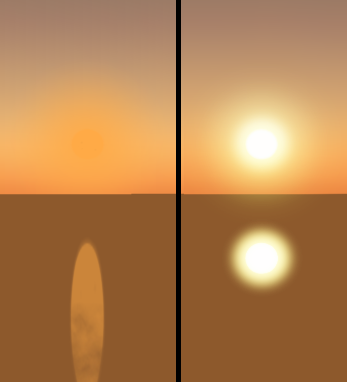
Figure A.


As I see it, there are three main problems with Second Life's sun and moon:
  1. Their reflections on water stretch unrealistically.
  2. They sometimes appear as dark or darker than the sky around them.
  3. Background stars are drawn in front of them.
Examine Figure A; the left half is raw, untouched snapshot of a near-sunset in SL at 300m; the right half is what I think it should look like. (NB: the bottom of the reflection is partially obscured by clouds.) Both problems 1 and 2 are in full force here.

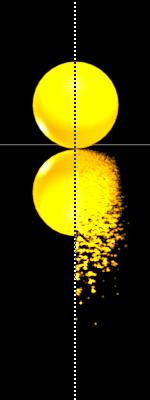
Figure B.

Optics minilesson #1: In the real world, a reflection of the sun or moon on the water appears stretched because of small irregularities (i.e. ripples) on the surface of the water which change the angle at which light is reflected. You can see this in Figure B, a test image I rendered in Blender using raytraced reflections. The image shows a lit sphere resting on a perfectly reflective surface. On the left side, the mirror is completely smooth; note that no stretching occurs in the reflection. On the right side, however, the mirror has small ripples which affect the angle of reflection, causing the same type of stretching seen in the real world.

My graphics card is not powerful enough to enable fancy water, so I, like many Residents, simply see an upside down and yuckily stretched version of the sun or moon in the water. I know the programmer who did that meant well—he or she just wanted to make it look as if there were ripples distorting the reflection. But all it accomplished was making it look like the Grid is a concave Discworld.

Optics Minilesson #2: In the real world, the sun can never appear as dark or darker than the surrounding sky for the simple reason that the brightness of the sky is due to partial scattering of the light from the sun. Most of the light from the sun passes through the atmosphere without much scattering, which is why the sun appears to be a circle with definite edges, rather than a vague patch of brightness.

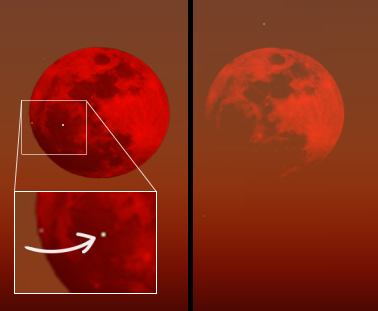
Figure C.

Optics Minilesson #3: The moon, too, will always appear at least as bright as the sky around it, never darker (as it does in the left half of Figure C). This is especially obvious on days when the moon is visible during the early morning or late afternoon; the unlit parts of the moon, which would appear black at night, appear the color of the sky.

Why does this occur, when mountains and skyscrapers do appear dark against the sky? Quite simply, because mountains and skyscrapers block the scattered light from the sky. The moon, because it is outside the atmosphere, does not block it.

Also note in Figure C the star appearing in front of the moon. That's just crazy.

Tuesday, November 21, 2006

Oi, clients.

This is not a rant. This is a cautionary tale.

I have done all my ranting about this issue in private conversation; ranting in public would do nothing to help it. I will not be naming names, and I ask that anyone familiar with the situation refrain from the temptation as well. I am not writing this to attack any individual, but as a general warning to others, and a reminder to my future self.

Over the past month, I have been working with an individual, "X", to thrash out the design for a large-scale building project. We went through several iterations of the design as I began to understand what X wanted. Finally, X was satisfied with the direction I was taking the design, and asked me to submit a formal bid—how long it would take to build, and how much I would charge to build it.

I mulled it over for a couple days, and sent my bid to X: estimates for what work I would be doing, how many hours each part of the work would take, when I would start construction, and when construction would be complete—along with my fee (regardless of how long it actually took to build). Given the number of hours of work estimated, I was charging about US $15/hour for construction, texture treatment, and scripting (my design allowed for the layout of the building to easily change with the client's needs).

It was, from my point of view, a fair offer. Given the scope of the project and the skills involved, I could have asked for much more than that. However, I am not a big-name well-established builder, so there is some amount of risk, from the client's viewpoint, that what I deliver would not meet the client's expectations. I took this risk into account in my fee, among many other risks on both sides. Confident that my offer was reasonable, I sent my bid to X.

To put it nicely, X was not prepared to pay what I asked, and rejected my bid.

To put it accurately, X snidely accused me of charging an excessive amount for my services and dismissed me without any further discussion.

X, it seems, would not pay more than a certain amount which, given the number of hours I had estimated as necessary, came out to less than US $3.50 per hour. Upon hearing this, I (trying to remain civil) asked X for verification of that rate, and asked if the number of hours I was estimating was, perhaps, more than would be necessary to achieve X's vision. X refused to discuss it.

Now, X had been a difficult client to work with during the design phase. X's "requirements" were vague, and in some cases contradictory or simply impossible given the realities of three-dimensional space. (On the other hand, if I were building for four-dimensional space, such pithy concerns as distance and volume could be ignored). I was warned by another builder who had worked with X. I had no reason to expect X to act rationally, but hope springs eternal.

The lessons I have learned (or had reinforced) are:

  1. Make sure the client knows what he/she wants before you begin, and can communicate it to you. Otherwise, you are trying to hit an unknown and possibly moving target, which is quite frustrating! It also increases the likelihood that the client will pull something new out of their hat halfway through the process.
  2. If you are designing a build in addition to constructing it, treat them as separate processes, and charge separately. Planning the design before you build is good on general principle, of course, and treating them as separate processes helps enforce that. On top of that, it ensures that you will be paid for the design work, even if the client changes his/her mind about hiring you for the building. I also recommend charging as-you-go for each revision of the design if possible, for the same reason.
  3. If the client is full of drama before you are working for them, they will probably be even more full of it while you are. If drama, headaches, and frustration are what you are searching for, this is good news. On the other hand, if you value your sanity, pass up that client.
  4. Contracts protect both sides. Write up contracts for every step of the way, outlining the expectations of both parties, and what should happen if those expectations are not met. Have the client sign/agree to each contract, then stick to it.

Sunday, November 12, 2006

Linden Lab to Instructors: kthxbye

Linden Lab recently announced that it would be ceasing the instructor subsidy program effective December 9—after that date, Linden Lab will no longer pay L$500 per class an Instructor teaches.

Apparently, this both upset and surprised a number of instructors! To them, this is the latest in a series of moves by Linden Lab to destroy everything we used to love about Second Life.

Me? I don't really care. I have never requested any subsidy payments for my teaching. I don't want hand-outs, and I'm not teaching as a favor to Linden Lab, so they can keep their money.

I take tips from students. At the end of (almost) every class, I mention that I do take tips, and that a contribution of any size is a good way to tell me that you appreciated the class—but that the class is free, and tips are entirely optional. I get paid iff my students think what I have taught them is worth paying me for.

On only one occasion have I received more in tips than I would have received as a subsidy payment; usually I receive about half. But I know I earned it.

There are two factors which, one might argue, make my situation unusual among instructors (and thus renders my opinion on this matter entirely invalid).

  1. I do not teach in SL as my means of survival. (I teach because I enjoy it, and to make a bit of spending money.)
  2. The material I teach is not geared towards newbies, but instead Residents who have been in-world for a while and wish to improve their skills for personal or commercial benefit. (Oldbies and professional builders are apparently more likely to have money on hand with which to tip someone who teaches them techniques to improve their building efficiency.)
"Of course you don't mind," writes an imaginary instructor. "You don't need the money, and besides, the way you teach is more profitable! I, on the other hand, have to teach a hundred newbies to put on their own pants just to make enough money to buy a pre-owned can of chicken broth!"

Yes, it's true: instructors who have been surviving on hand-outs from Linden Lab in return for teaching newbies the utter basics are getting the shaft. Tough break for you? My only advice is to adapt your business model. Find a business to sponsor your class. Start charging for admission. Teach something that people with money will pay you to teach.

Linden Lab is, in some ways, giving themselves and every Resident on the Grid the long-term shaft, too. Hordes of the unwashed masses are already trampling everything; now they will be unwashed, uneducated masses! Terrible, disgusting plebians whose purest motive in SL is to figure out how to attach a giant penis to their own forehead and find the nearest free sex community.

Boy, the Grid is going to /dev/null in a handbasket, I tell ya. It's enough to make me yearn for ye dayes of olde when a prim was a just a prim, grass textures were greener and never had to rez, and every Resident descended onto Help Island from the immaculate Skybox of knowledge and dedication.

Those were the days.

Monday, November 06, 2006


This is all.


(It's enough.)

Sunday, October 08, 2006

My Agenda

I didn't conciously realize this when I first started writing here, but my feature requests have a very specific agenda. To put it succinctly:

I want Second Life to be more like a high-level 3D modelling application.

My education is in 3D computer modelling and animation, and I have a good understanding of computer programming. Thus, my perspective on Second Life is from the angle of someone who uses high-level modelling and animating tools like Maya and Blender, and high-level programming languages like Ruby, Python, and LISP.

The tools offered in Second Life are technically inferior to just about everything I have used, but it has the definite advantages of being collaborative, interactive, and visible.

By collaborative, I mean that many people can use it and work on a single project at the same time, in the same working space. Rather than many people working separately on their individual parts, we can come together and build something together, watch each other build, and see how our work fits within the whole project.

By interactive, I mean that there is a great degree of communication between the user and the tool, and between the user and other users. You can see the changes you are making as you make them. And not only can you see them, but your partners can see them. This makes Second Life an excellent platform, again, for collaborative work, but also for education and error correction: rather than a teacher seeing only the finished product of a student's work, the teacher can see the student's process and suggest improvements to it.

By visible, I mean that the work exists in a "real" space where audiences can see it. Gallery spaces can be created and work arranged within that space for people to see. Multiple viewers can see it at once, discuss what they see and think about it, and interact with each other and with the artist. This has a definite advantage over a simple web page with several images ordered sequentially. It even has an advantage over a web forum where users can post work and comment on the work of others.

To bring all these points together: the high level 3D modelling applications that I use are missing something which Second Life has; and Second Life is missing something that the modelling applications have.

But there's more to the story than just that.

High-level 3D modelling applications have a lot of features which are not necessary or even useful in the context of Second Life, for reasons technical and otherwise. It is not my agenda to graft unneeded and pointless features onto Second Life. Doing so would waste resources which would be better used on more important things.

Second Life is a lot more than a distributed 3D modelling platform. It has social, commercial, educational, and recreational value, all of which are undeniably important parts of what make Second Life what it is. It is not my agenda to reduce or remove any of these facets of Second Life. They are the reason and purpose for the 3D modelling aspect to exist; without them, Second Life would be pointless.

And yet, just as tools without a purpose would be pointless, a purpose without the tools to fulfill it would be squanderage. The scenery of Second Life is a critical part of its social, commercial, education, and recreational value. It is toward the purpose of fulfilling the potential of Second Life that I propose features and changes. Every feature I suggest, I do so because the benefit towards fulfilling important values would be far greater than the cost of implementing the feature.

I want Second Life to be more like a high-level 3D modelling application...

...because that would facilitate the creation of new, interesting, beautiful, and useful things which would enrich Second Life.

Monday, September 11, 2006

Defining ourselves

Mera offered a thought stream which got me thinking about deriving identity in activity—the idea that you are what you do. If you center yourself around doing N, who would you be if you stopped doing N?

(I am reminded here of the crises of people who, after working their entire lives at the same job, reach retirement and are at a loss as to how they should spend their time. The job had become their identity.)

This struck a chord with me because I do tend to derive a lot of my identity from what I do. In both Lives, I keep myself perpetually buried in projects, so that I will always have some activity to define myself in relation to.

I create, so I am a creator.
I teach, so I am a teacher.
I do, so I am.


Assuming, of course, that it is undesirable to be left in a state of doubt about one's identity, one should endeavor to prevent and cure such a state. Defining oneself in relation to only one or two things is risky; interests come and go, and the anchor that holds today may not tomorrow. A less risky option (and the one I am prone to do) is to grab hold of as many activities as possible, so that each matters less. If one fails, the others are there as backup. But there is a danger to this too, that of spreading oneself too thin, so that there is no meaningful benefit in anything.

No matter how we define ourselves in relation to other things and activities, there is always the very real possibility that we will lose or shift away from them.

But what if we define ourselves not in relation to something else, but as being ourselves, no matter how we change?

I am myself.
I look a certain way, act a certain way, and enjoy certain things.
In the future, I will look another way, act another way, and enjoy other things.
I will be myself then, too.


(We'll see.)